See this topic:
To my surprise the postcode in question, J0X 1E0, is popping up in 5 clusters:
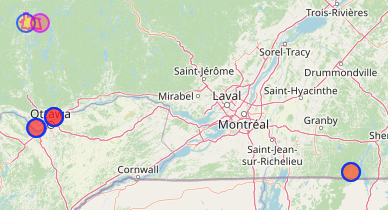
Zooming in around the places I see more variation in postcodes then I would expect. What is going on?
See this topic:
To my surprise the postcode in question, J0X 1E0, is popping up in 5 clusters:
Zooming in around the places I see more variation in postcodes then I would expect. What is going on?
In a less than 0.1 sq km area I found 19 different values for the addr:postcode tag:
Yeah, there are (/were…) two problems here:
resulted in Nominatim putting the geographical ‘midpoint’ of the J0X 1E0 postal code in Ottawa.
I’ve since fixed the postal codes of the affected buildings/park.
Someone should really go back through all of the buildings’ postal codes in Gatineau; many of them are a hodgepodge when they should generally be consistent along one side of a street for at least a block or two.
Problem solved @Joseph_Olstad!
Thank you! I look forward to seeing how this works out next week.
Should we even have Canadian postal codes in OpenStreetMap? Canada Post created all of these postal codes, and treats such data as proprietary, as was seen in its litigation against geocoder.ca. And my impression from that is that Canada Post has no intention of ever licencing such data for use in products like OpenStreetMap without charging a massive prohibitive fee.

Canada Post did indeed sue Geolytica, the company that operates geocoder.ca, asserting copyright over postal codes, but the lawsuit was dropped ten years ago. They were roundly ridiculed by the press and public for the absurd assertion that: 1) an individual publicly sharing a postal code was violating Canada Post’s copyright on their postal code database, and 2) the phrase “postal code” itself was copyrighted by Canada Post.
Can we as OSM mappers use Canada Post’s Postal Code Address database? No. Canada Post will licence this data for commercial use for a fee, and they do not have any open licencing for this data. Can we input postal codes into the OSM database sourced from elsewhere? Yeah, absolutely.
But where did “elsewhere” get their postal code data? Its traceability chain goes all the way back up to Canada Post, which means the data copyright cascades all the way down, allowing Canada Post to continue to breathe down the necks of projects like ours. Canada Post did not promise not to take any more legal action with regard to any of its data being re-agglomerated in bulk.
Well I guess you’re not going on my Christmas card list, because I can’t know your address without you violating Canada Post’s copyright. After all, where did you get your own postal code from? 
Canada Post dropped their suit against Geolytica precisely because they were going to lose, badly.
On an extreme scale, if I add in the postal code of the building I live in, is Canada Post breathing down our neck?
They assigned the postal code, but I would not say they own it or get to control how it is used, other than commercial arrangements (selling databases of postal codes to people who choose to buy them).
In particular, database rights aren’t a thing in Canada. Conceivably, the use of Canada Post website or other resources provided directly by Canada Post could be subject to some terms and conditions that aim to protect the database, but that’s separate.
Until there is a new court ruling that says that Canada Post is able to prevent independent re-assembly of postal codes, I would say we’re pretty in the clear.
Until there is a new court ruling that says that Canada Post is able to prevent independent re-assembly of postal codes, I would say we’re pretty in the clear.
Unfortunately, this page seems to suggest the opposite. Facts cannot be copyrighted, but this page argues compilations of them can be.
Sorry, I’m not clear how that page applies to the topic of postal code data.
What kind of “skill and judgment”, as defined on that page, would you argue is involved in Canada Post having a list of all postal codes they issued?
Is there any evidence that Canada Post has registered their postal code “compilation” with the CIPO, as outlined on that page?
And even if yes, what is the argument that manually collecting postal code data (not copying from Canada Post) violates any kind of database rights that might exist?
Did anyone hire a lawyer and ask them for a professional opinion?
Was there a court judgment?
Because there was no court judgment either in favour of or against Canada Post’s actions, that basically leaves Canada Post with status quo ante, and if it wants to go after another third-party aggregator of postal codes, there is nothing stopping it. So as a CYA, I still believe Canadian postal codes are not appropriate for inclusion in OpenStreetMap. The legal risk is still there.
The “skill” came from workers at Canada Post who painstakingly, remember this was back in the late 60’s and early 70’s, went through every single street and postal address in Canada and gave it a unique six-character code based on how efficient Canada Post thought it would make the job of letter carriers when they walk their routes delivering mail. That was an incredible amount of work Canada Post went to in making such a database, and the database is original enough that Canada Post can claim copyright on it.
Step 1: Assessing Originality (Skill and Judgment) is completely clear to me
For example, simply listing every business in Alberta alphabetically lacks skill. However, creating a highly curated database of “Top Sustainable Tech Companies in Calgary,” categorized by unique environmental metrics, likely demonstrates the required originality.
No the skill of assigning post codes is not relevant here.
I think this Situation of Canada Post owing the data is stupid would make sense to lobby the government to make that open data.
Or at least talk to our MPs in a bid to get a law passed to force Canada Post to release its postal code database as open data. But I suspect that would only cause Canada Post to lose even more money, so Canada Post would argue very fervently against something like this.
Haha, no, postal codes were not created by Canada Post workers “painstakingly going through every single street and address, and giving it a unique six-character code based on how efficient it would make the letter carriers’ jobs”: the work was largely done by computer by Canada Post’s “Coding and Mechanization Branch”, and the purpose was to make it easier for new automated sortation machines at the postal depots to use optical character recognition. Canada Post workers themselves were vehemently opposed to this, and the CUPW went on strike several times in the early and mid-1970s in opposition to the implementation of postal codes.
As I wrote months back: Canada Post’s database is not licensed for open use, and we as OSM mappers can’t copy from it. The database itself, taken as a whole, has copyright protections. The postal codes themselves are just pieces of factual information, and have no copyright protection. You’re correct that this was never conclusively litigated in the Geolytica suit, because Canada Post withdrew the suit. Do we as OSM mappers have a proverbial sword of Damocles hanging over us if we input postal codes into the OSM database? If you scrape data from Canada Post directly: yes, absolutely that’s problematic. From elsewhere? Canada Post are welcome to try to assert copyright again, but I doubt very much that it’ll go anywhere, and they’ll be roundly ridiculed like they were ten years ago.
The new “Référentiel québécois des adresses” published by the MRNF (Ministry of natural resources) in Quebec, includes the postal code for every address in the Quebec province, and it is provided with the license CC-4.0 on their Open data website. https://www.donneesquebec.ca/recherche/dataset/referentiel-quebecois-des-adresses
I am pretty sure the government knows what they are doing here, so at least in Quebec, you can use postal codes from this open database. However, do not import the data into OSM yet, as we are still waiting for a formal waiver to include MRNF data into OSM. Data from MTMD and Ministry of Tourism has already been accepted to be included into OSM: FR:Ministère des Transports et de la Mobilité Durable - OpenStreetMap Wiki
FR:Ministère du Tourisme du Québec - OpenStreetMap Wiki